Why Gulf Energy Operators Are Watching the Wrong AI Regulation
The convergence gap — between the framework you track, the one enforcing on you today, and the operational layer where your AI now lives — is opening across IT, OT, and the boardroom.

Somewhere in the Gulf right now, an energy operator is standing up a computer-vision system to flag unsafe behavior on a rig floor, or a model that reads sensor data to estimate methane leakage across a field. The technology is sound. The business case is obvious. And the governance review almost certainly opened with the same question being asked in compliance functions from Houston to Rotterdam: how do we align this with the EU AI Act?
It is the wrong first question. Not because the EU AI Act is irrelevant — for any operator with European customers, partners, or parent reporting, it is unavoidable — but because it is the framework that just blinked, while the regime actually issuing enforcement decisions against firms in this region barely features in the conversation at all.
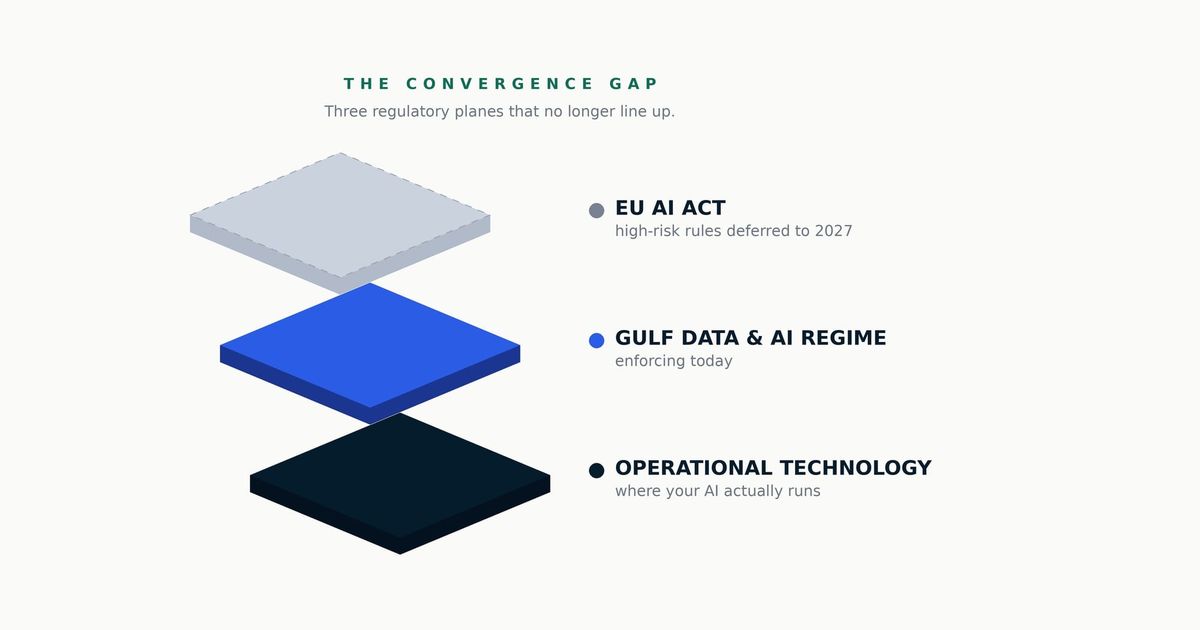
That mismatch is the convergence gap. It is not a single regulation. It is the widening space between the rules you are watching, the rules that are enforcing on you today, and the operational layer where your AI now actually lives.
For an energy operator running converged IT and operational technology across multiple jurisdictions, that gap is not a compliance footnote. It is an architectural risk.
The framework everyone watches is the one that just slowed down
The EU AI Act has dominated the AI-governance conversation since it entered into force in 2024. It is the world's first comprehensive horizontal AI law, it has extraterritorial reach, and its high-risk provisions explicitly cover AI used in the management and operation of critical infrastructure — which is precisely where industrial energy AI sits.
But in 2026, the EU did something instructive: it pushed the brake. Under the Digital Omnibus — a political agreement reached in May 2026 and, at the time of writing, still pending formal adoption — the high-risk obligations for the systems most relevant to industrial operators are being deferred well into 2027, with product-embedded systems pushed further still. The transparency rules around AI-generated and synthetic content remain on a nearer horizon, but the heaviest lift for critical-infrastructure AI has been given more runway.
For a board, that delay is easy to misread as breathing room. It is the opposite. It means the framework with the loudest profile and the most consultancy decks behind it is also the one telling you to take your time — at the exact moment the regimes closest to you are accelerating.
The framework nobody outside the region tracks is the one enforcing today
Look one border over. Saudi Arabia's Personal Data Protection Law has been fully enforceable since September 2024, and the Saudi Data and Artificial Intelligence Authority — SDAIA — reported issuing dozens of enforcement decisions in its first wave, spanning unlawful processing, inadequate security controls, and unauthorized disclosure. This is not a guidance phase. It is an adjudication phase, run through a formal committee process on an electronic platform, with response windows measured in days, not weeks.
Three features make this acutely relevant to energy operators:
- It is extraterritorial. The law reaches any entity processing the personal data of individuals in the Kingdom, regardless of where that entity is established. A European EPC contractor or a joint-venture partner headquartered abroad does not sit outside it.
- It now has an explicit AI overlay. In late 2025, SDAIA published an AI Adoption Framework, and Saudi Arabia designated 2026 a national year of AI. Industrial AI that touches personal data — and computer-vision safety systems watching workers unmistakably do — now carries a parallel set of governance expectations layered on top of the data law itself.
- Its cross-border rules are unresolved in exactly the way that bites JV structures. Transfers out of the Kingdom run through a dedicated regulation requiring approved contractual safeguards and, in higher-risk cases, a prior transfer risk assessment — and the official list of "adequate" destination countries has not yet been published. For an operator routing operational and personnel data between Saudi sites, a UAE shared-services hub, and a European parent, that is not a theoretical exposure. It is a live one, every day data crosses the border.
The United Arab Emirates, meanwhile, is not standing still either. In mid-2026 it consolidated AI oversight, digital-government functions, and data regulation under a single federal authority — a structural change recent enough that most compliance maps drawn last year are already out of date. Its information-assurance standard for critical entities has been modernized into a new version, and harm to critical infrastructure now carries penalties reaching into the millions of dirhams. The instruments many operators still refer to by their old names have been restructured underneath them.
Why energy is the sector where the gap actually hurts
Most enterprises can treat AI governance as an extension of their data-governance programme and move on. Energy operators cannot, for a structural reason: they run on the convergence of information technology and operational technology, and AI is now being injected directly into the OT layer — the part of the estate that regulators and security teams alike historically treated as a walled garden.
Computer vision on the rig floor, anomaly detection on pipeline telemetry, predictive maintenance on rotating equipment, emissions estimation from sensor arrays — these are not back-office analytics. They are AI systems making or informing decisions inside safety-critical, physically consequential processes, frequently fed by data that crosses borders and, often enough, identifies people.
That places the energy operator at the intersection of three planes that do not line up:
- The plane you are watching — the EU framework, high-profile but newly deferred.
- The plane enforcing on you — the Saudi data and AI regime, active now, and the restructured UAE authorities.
- The plane your AI actually runs on — operational technology, where governance maturity is typically lowest and where "this is an OT system, the data rules don't really apply here" remains a dangerously common assumption.
The gap is the misalignment between those three. A checklist built for one plane will not close it, because the planes are calibrated to different scopes, different timelines, and different definitions of what even counts as in-scope.
The four blind spots this opens
For executives who want something concrete to take into the next governance review, the convergence gap tends to surface as four recurring failures:
- Watching the wrong clock. Anchoring the program to the EU timeline lulls the organization into a deferral posture while the regime with jurisdiction over your regional operations is issuing decisions today. The clock that matters is the one running in the country where your data and your workers are.
- Separating AI governance from data governance. In the Gulf, they are converging by design — a data law with an AI framework layered on top. Treating an industrial AI deployment as a "technology project" rather than a regulated processing activity skips the very step regulators are now examining.
- Underestimating cross-border residency in JV structures. The most exposed flows are the routine ones — operational and personnel data moving between national operating companies, regional hubs, and foreign parents. Absent published adequacy lists, every one of those flows needs an explicit, documented safeguard. "We've always moved it this way" is not a safeguard.
- Leaving OT out of scope. The assumption that operational technology sits outside data and AI governance is the single most expensive blind spot, because OT is precisely where the highest-consequence AI is now being deployed and where the least governance maturity exists.
The reframe: resilience is an architecture, not a checklist
The instinct, faced with three misaligned regimes, is to build three compliance checklists and reconcile them. That instinct fails — not because the checklists are wrong, but because they are static answers to a moving problem. The frameworks will keep shifting timelines, authorities will keep restructuring, and AI will keep migrating deeper into the operational core. A checklist describes a moment. The estate you are governing does not hold still.
What closes the convergence gap is not a longer checklist but a different posture: treating regulatory resilience as an operating model rather than a project. That means governance designed around the flow of data and decisions across the converged IT/OT estate, not bolted onto an org chart; controls expressed once and mapped to many regimes, so a new authority or a shifted deadline is a re-mapping exercise rather than a fire drill; and an explicit decision discipline for when an AI system may be deployed, by whom, and against which jurisdiction's rules.
An operating model survives a delayed EU deadline, an accelerated Saudi enforcement wave, and a UAE authority that reorganized last quarter — because it was never pinned to any single one of them.
What to do before the next board meeting
Three moves, in order:
First, inventory where AI now touches your operational technology — not your IT systems, your OT. Most organizations cannot answer this question on demand, which is itself the finding.
Second, map your cross-border data flows against the regime that has jurisdiction where the data originates, not the regime with the highest profile. For most operators in this region, that means starting with the Saudi and UAE positions, not the European one.
Third, stop asking whether you comply with a given framework and start asking whether your governance model can absorb the next change to it without breaking. If the honest answer is no, the gap is already open.
The operators who navigate the next two years well will not be the ones with the thickest compliance binders. They will be the ones who built an architecture resilient enough that the regulatory weather — fast in Riyadh, restructured in Abu Dhabi, deferred in Brussels — stops being a series of emergencies and becomes simply the climate they were designed to operate in.
This article is strategic and governance analysis written from an enterprise IT, cybersecurity, and risk-management perspective. It is not legal advice. Regulatory timelines referenced here — particularly the EU Digital Omnibus amendments — remain subject to formal adoption and should be confirmed against primary sources before any compliance decision.