The Next Governance Crisis: When Organizations Begin to Run Themselves
When agentic AI meets smart contracts, organizations can sense, decide, contract, pay, and act on their own. Our governance frameworks assume a human in the loop. What happens when there isn't one?

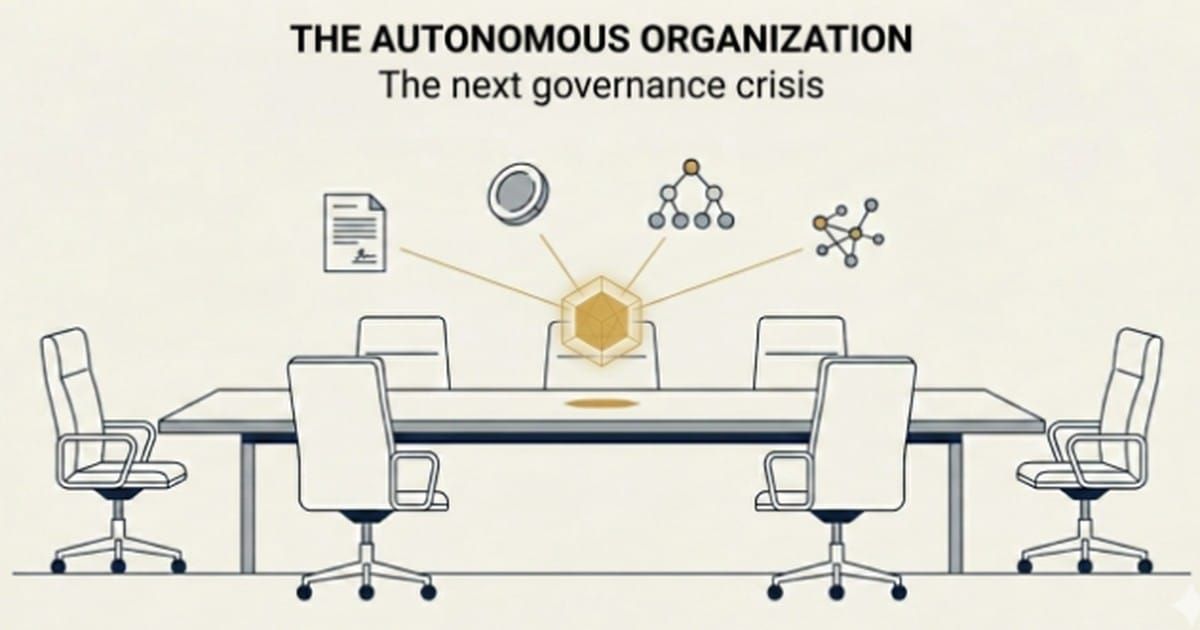
For most of modern history, organizations have been governed through a visible chain of human judgment.
A manager approves an expense. A board ratifies a strategy. A regulator inspects a process. A court assigns liability.
The law, the market, and the public all assume one thing:
Somewhere in the loop, a human being is accountable.
That assumption is beginning to dissolve.
Two powerful technologies are now converging.
Agentic AI is moving beyond chat interfaces and into operational work: reading documents, coordinating across systems, calling APIs, drafting contracts, approving workflows, and acting on conclusions.
Blockchain and smart contracts add a second layer: programmable execution that can move money, enforce agreements, and record activity without relying on a traditional intermediary.
Together, they make something fundamentally new possible: an organization that can sense, decide, contract, pay, adapt, and act with limited human intervention.
Not just automated workflows. Not just digital companies. But semi-autonomous economic actors.
And that raises a question our governance systems are not yet prepared to answer:
What happens when an organization begins to run itself?
What this could look like
Imagine a supply chain entity that monitors demand, negotiates pricing, executes purchase orders, releases payments, and rebalances inventory without waiting for a procurement manager.
Or an investment vehicle that scans markets, takes positions, reallocates capital, and distributes returns to token holders without a traditional portfolio manager.
Or a research consortium that evaluates proposals, funds the strongest submissions, licenses intellectual property, and distributes royalties through self-executing contracts.
These are no longer science-fiction scenarios.
DAOs have already shown that capital, governance rights, and economic coordination can exist outside traditional corporate forms. AI agents are already being given browser access, enterprise system permissions, tool-calling capabilities, and in some cases payment authority.
The direction of travel is clear: more autonomy, more scope, more consequential decisions.
The real question is not whether autonomous organizations will emerge. They already are.
The question is whether our legal, regulatory, and governance frameworks can keep up.
Why today's frameworks break
Almost every existing governance model assumes a human decision point.
Corporate law assumes directors. Tax law assumes residency. Liability law assumes an accountable person. Antitrust law assumes intent. Securities law assumes an issuer. Compliance frameworks assume someone can explain, approve, and be held responsible.
But what happens when the "directing mind" is not a boardroom, a CEO, or a committee?
What happens when it is a model running inference, executing through smart contracts, and operating across jurisdictions no single person fully controls?
Then the basic questions become difficult:
- Who is liable when an autonomous organization causes harm?
- Which jurisdiction governs an entity that exists as code on a distributed network?
- How do you tax an organization with no traditional domicile?
- What does fiduciary duty mean when there is no identifiable fiduciary?
- Can an autonomous organization be sanctioned, dissolved, or held in contempt?
These are not philosophical edge cases.
They are the next decade of governance.
The real risk: capability without accountability
The danger is not that autonomous organizations will exist. They will.
The danger is that capability will outrun accountability.
That we will grant AI agents operational authority before defining legal responsibility. That we will allow smart contracts to execute economic decisions before establishing meaningful oversight. That we will discover the governance gap only after a high-impact failure forces the question.
We have seen this pattern before.
Social media scaled before content governance matured. Crypto markets expanded before regulatory clarity arrived. Platform labor reshaped employment before labor protections adapted.
Each time, innovation moved first. Governance arrived later — often reactive, fragmented, and incomplete.
Autonomous organizations could repeat the pattern, but with a sharper edge.
Because this time, the system may not just influence human behavior.
It may act.
What governance must start asking now
There is a better path. It begins with the unfashionable work of building governance before the crisis.
That means:
- Legal recognition frameworks for autonomous and semi-autonomous entities
- Mandatory human checkpoints for high-impact decisions
- Transparent audit trails for agent actions and smart contract execution
- Clear liability models for developers, operators, token holders, boards, and sponsors
- Jurisdictional rules for entities that operate across borders by design
- Kill-switch, pause, and escalation mechanisms for autonomous systems
- Board-level visibility into where autonomous agents already operate inside the enterprise
But it also requires honesty inside companies.
Boards and executive teams should be asking now:
- Where do autonomous agents already operate in our organization?
- What systems can they access?
- What decisions can they make?
- Can they trigger payments, change records, approve workflows, or commit the company contractually?
- What could go wrong?
- And if something does go wrong, who answers for it?
These questions should not wait for regulators.
They belong in boardrooms today.
The governance moment is arriving
The next governance crisis may not come from a rogue employee, a failed board, or a non-compliant vendor.
It may come from an entity that was never designed to fit neatly into our existing categories.
Not quite a company. Not quite software. Not quite a fund. Not quite a platform. But capable of acting like all of them.
Autonomous organizations will test the foundations of corporate law, regulation, taxation, liability, and accountability.
And the hardest question will not be technical. It will be institutional.
The technology is becoming ready to act.
The question is whether our institutions are becoming ready to govern.
Where do you see the autonomous-organization question landing first in your industry?