India Is Building Its AI Future on Water It Doesn't Have
The Aquifer and the Algorithm: a water-first policy agenda for India's data center heartland — Karnataka, Maharashtra and Andhra Pradesh.

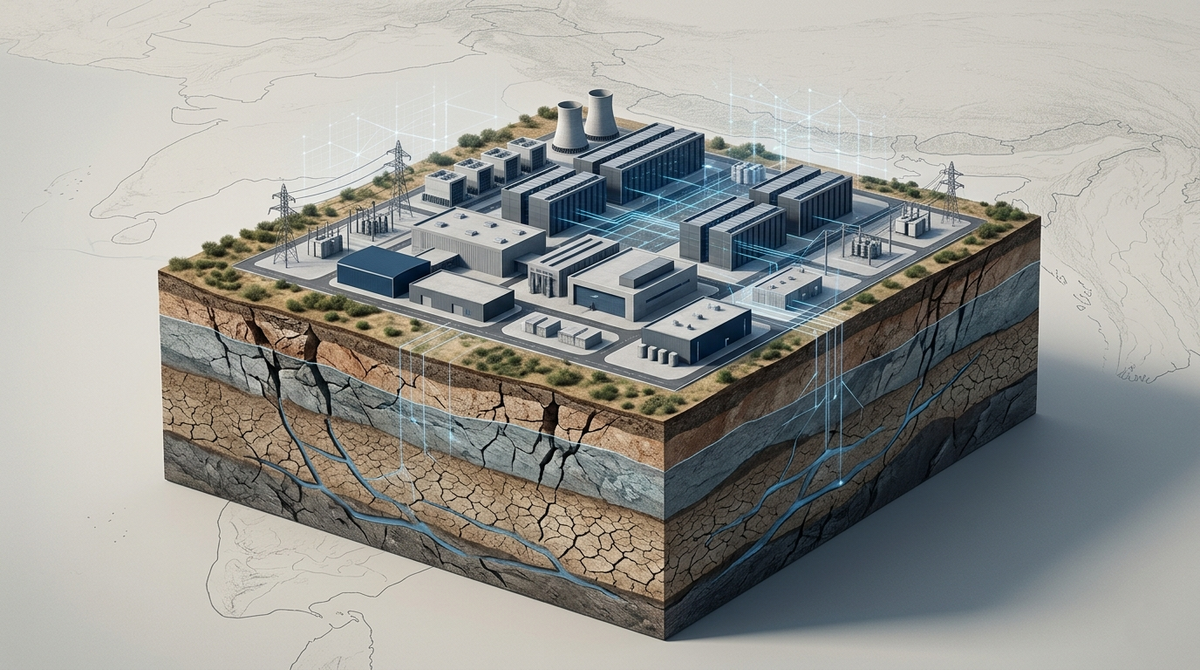
India is building the digital infrastructure of its future. The question is whether we are also governing the natural infrastructure that future depends on.
Artificial intelligence, cloud computing, data localization and digital sovereignty all require a massive expansion of data-center capacity. India needs that capability. It is strategic, economic and, increasingly, geopolitical.
But there is a risk we are not discussing with enough seriousness: water.
This is not an argument against data centers. It is an argument for building them with the same discipline we apply to any other critical infrastructure decision — visibility, controls, accountability and an honest understanding of local risk.
I am not a hydrologist. But governance is my discipline, and risk is the lens through which I read any large infrastructure build-out.
What I see in India's data-center expansion is a classic enterprise-risk problem: aggregate numbers may look manageable, while local concentration creates serious exposure.
A portfolio can look healthy while one concentrated position threatens the whole book.
Water is exactly that kind of risk.
The national number is not the real risk
India has about 18% of the world's population but only around 4% of global water resources. It is also the world's largest user of groundwater, and NITI Aayog has warned that hundreds of millions of Indians already face high to extreme water stress.
Meanwhile, India's data-center market is expanding fast. Installed capacity grew from roughly 520 MW in 2020 to nearly 1.5 GW by mid-2025, with credible projections from CEEW/Systemiq, Colliers and S&P Global placing it in the range of 4.5–6.5 GW by 2030. Industry estimates also suggest that annual data-center water use could more than double during the same period.
On a national scale, that water footprint may look small compared with agriculture, municipal demand or power generation. But national average consumption is the wrong lens.
The real risk is local concentration.
A small national percentage can still become a major stressor when it clusters in an already water-stressed watershed, an over-exploited groundwater block, or a rapidly urbanizing corridor where communities already compete for reliable supply.
The data points in that direction. S&P Global projects that 60–80% of operating data centers in India and Australia could face high water stress this decade, while WRI India analysis indicates that more than half of India's data centers are located in water-stressed regions.
Water does not respond to GDP forecasts, investment MoUs or policy ambition. It responds to what is withdrawn from a specific location and what nature can return to that location.
That balance is now being shaped, watershed by watershed, in data-center approvals across the country.
The hidden water footprint of digital infrastructure
Data centers are often marketed around efficiency: lower PUE, greener campuses, renewable power and, in some cases, "zero-water cooling."
These are useful improvements. But viewed too narrowly, they can paint an incomplete picture.
The visible water footprint inside the facility is only part of the story.
A 2026 analysis by Xylem and Global Water Intelligence projects that AI's additional water demand will be driven mainly by power generation and semiconductor fabrication, with data-center expansion accounting for a smaller share. That does not make data centers irrelevant. It means their full water footprint must be assessed across the facility, the grid and the hardware supply chain.
A facility may reduce direct water use through dry or closed-loop cooling. But if its electricity comes from thermal generation, water may still be consumed upstream at the power plant. Similarly, the semiconductor supply chain behind AI hardware carries its own water intensity.
This is why Water Usage Effectiveness measured only at the facility boundary is useful, but incomplete.
For policymakers, the question should not be only: "How much water does the cooling system use?"
The better question is: "What is the full water impact of this facility, in this watershed, over its operating life?"
That is the governance question.
Three states, three different water challenges
The challenge is not uniform across India. Maharashtra, Karnataka and Andhra Pradesh illustrate three different versions of the same policy problem.
Maharashtra: scale and concentration
Maharashtra remains one of India's most important data-center hubs, particularly around Mumbai and Navi Mumbai. The state has also moved earlier than many others in developing a green data-center framework, including ambitions around integrated parks, renewable energy and sustainable campuses.
That is a genuine head start.
But the unresolved tension is concentration.
Mumbai's coastal and humid climate shapes cooling choices, and the energy mix still matters. If clean power and water-efficient design are not built into the approval model, water consumption may simply shift from the facility to the power system.
There is also an equity dimension. Mumbai already faces uneven water access across formal and informal settlements. Large digital infrastructure projects must therefore be assessed not only as investment assets, but also as local resource users.
A city can be digitally advanced and still water insecure.
That contradiction has to be confronted directly.
Karnataka: the cautionary tale
Karnataka is central to India's technology economy. Bengaluru is a global technology brand, and the state's ambition to attract data centers is understandable.
But Karnataka also shows why investment-led clearance alone is not enough.
Bengaluru and its surrounding growth corridors have already experienced serious water stress. Devanahalli, on the city's northern edge, has become a major development corridor despite limited local water availability and dependence on stressed groundwater and external supply arrangements.
This is where governance must become sharper.
Data-center approvals cannot rest only on land, power availability, investment size and employment potential. They must include a local water-budget test. If a region is already stressed, the burden of proof should be higher, not lower.
In governance terms, water availability is a material control, not an environmental footnote.
Andhra Pradesh: opportunity with conditions
Andhra Pradesh is positioning itself aggressively in the data-center and AI infrastructure race, with Visakhapatnam emerging as a major focal point. Google's announced investment of approximately $15 billion over five years for an AI hub in Visakhapatnam has made the state central to India's digital-infrastructure story.
The opportunity is significant.
But so is the responsibility.
Visakhapatnam raises real questions about water availability, environmental disclosure and community confidence. Civil-society groups and environmental reporting have flagged concerns about water stress, operational water use and the adequacy of public disclosure.
Andhra Pradesh does hold one structural advantage: geography. Coastal facilities can, in principle, use seawater-based cooling and reduce dependence on freshwater. That is the right direction.
But "we will use seawater" is not a control until it is written into the license, monitored independently and reported transparently.
The freshwater–seawater split should be binding, measurable and publicly auditable.
The real issue is governance
Strip away the environmental vocabulary, and this becomes a familiar governance problem.
There are three gaps.
1. The measurement gap
You cannot govern what you do not measure.
India needs facility-level disclosure of water use, energy use, cooling design, power sourcing and local water dependency. This should include both direct water use and, where feasible, the embedded water footprint of electricity.
The European Union has already moved in this direction. Its revised Energy Efficiency Directive requires data centers above 500 kW to report energy- and water-related performance indicators.
India should study that model and improve on it by ensuring transparency at a level meaningful to affected communities.
Disclosure that local communities cannot see is not real accountability.
2. The siting gap
Current data-center policy frameworks often prioritize investment attraction, single-window clearance and speed of execution.
These are important, but incomplete.
For water-intensive infrastructure, siting must be tied to hydrological carrying capacity.
The Central Ground Water Authority already classifies areas by groundwater stress. That classification should weigh directly in approval decisions. A data center drawing fresh groundwater should not be approved in an over-exploited block unless there is a clearly defined, independently verified, non-potable or alternative water source.
In simple terms: water-stressed locations should face stricter controls, not a faster lane.
3. The accountability gap
Many companies now speak of becoming "water positive" by 2030. The ambition is welcome, but it can mislead if offsets are treated as interchangeable across locations.
Restoring water in one watershed does not automatically compensate for depletion in another.
Water is local. Aquifers are local. Community impact is local.
Offsets should therefore be local, measurable and additional. They should supplement absolute limits on local abstraction, not replace them.
A control that can be satisfied somewhere else is not a strong control.
A water-first agenda for India's data-center growth
India does not need to choose between AI ambition and water security. But it does need to govern the trade-off honestly.
Six practical steps can help.
1. Make water-budget clearance mandatory
Every data-center approval should include a basin-level or watershed-level water assessment. The assessment should show available recharge, competing local demand, projected withdrawal and climate sensitivity over the facility's life.
This should be a pre-clearance requirement, not a post-approval formality.
2. Restrict freshwater use in stressed areas
In over-exploited or critical groundwater blocks, fresh groundwater abstraction should be prohibited or tightly restricted.
Operators should be required to use treated wastewater, recycled water, harvested rainwater, seawater where practical, or other verified non-potable sources.
Freshwater should be the exception, not the default.
3. Mandate transparent facility-level reporting
Operators should publicly disclose water use, cooling design, WUE, energy source, renewable-power share and wastewater-reuse levels.
India should not wait for a crisis before building transparency. Public reporting creates pressure for better design, better siting and better operating discipline.
4. Link cooling choices to power sourcing
Dry and closed-loop cooling can reduce direct water use, but they may increase electricity demand. If that power is fossil-heavy, the water burden may simply move upstream.
Cooling mandates must therefore be paired with clean-power requirements.
A water-efficient facility on a water-intensive grid is only a partial solution.
5. Use geography intelligently
Coastal sites should be encouraged toward seawater-based or other non-freshwater cooling where technically and environmentally feasible.
Inland growth should be steered toward locations with stronger water availability and renewable-energy access.
Policy incentives should reward the right siting decision, not only the fastest land acquisition.
6. Set absolute local caps
Net-positive commitments are not enough. Local abstraction limits should be hard, measurable and enforceable.
A data center should operate within a defined local water ceiling.
If that ceiling cannot be met, the design, water source or location should change.
The irreversibility test
Some infrastructure mistakes are recoverable. Others are not.
Energy systems can be decarbonized over time. Technology can become more efficient. Cooling systems can be retrofitted. Power-purchase agreements can change.
But depleted groundwater, especially in hard-rock aquifers across parts of peninsular India, may not recover on a business-planning timeline.
Once an aquifer is damaged, the cost is not only financial. It is social, agricultural, ecological and generational.
That is why water risk must be governed before construction, not after communities begin to feel the impact.
Build the future, but build it on water we have
India should absolutely build its AI and digital-infrastructure future.
Data centers are now part of national competitiveness. They support cloud services, AI workloads, data sovereignty, cybersecurity resilience and economic growth.
But the foundation of that future cannot be invisible.
Water is not a secondary input. It is a critical dependency.
The question for policymakers is not whether India should build data centers. It should.
The question is whether we will build them with the discipline to ask:
Where is the water coming from? Who else depends on it? What happens in a drought year? Who measures it? Who reports it? Who is accountable if the local aquifer declines?
These are not anti-technology questions. They are governance questions.
India's digital future should be ambitious. It should also be transparent, resilient and water-secure.
The algorithm may define the next economy. But the aquifer will decide whether that economy is sustainable.
Source note: This article draws on publicly available material from the World Bank, NITI Aayog/PIB, CEEW/Systemiq, S&P Global, WRI India analysis/mapping, Xylem/Global Water Intelligence, Google, the European Commission, and reporting from Mongabay-India, Down To Earth and the Earth Journalism Network, alongside civil-society statements on data-center water risk and environmental disclosure. The author is an IT infrastructure, cybersecurity and governance practitioner with decades of global enterprise experience and a long-standing interest in water conservation. Views are personal.